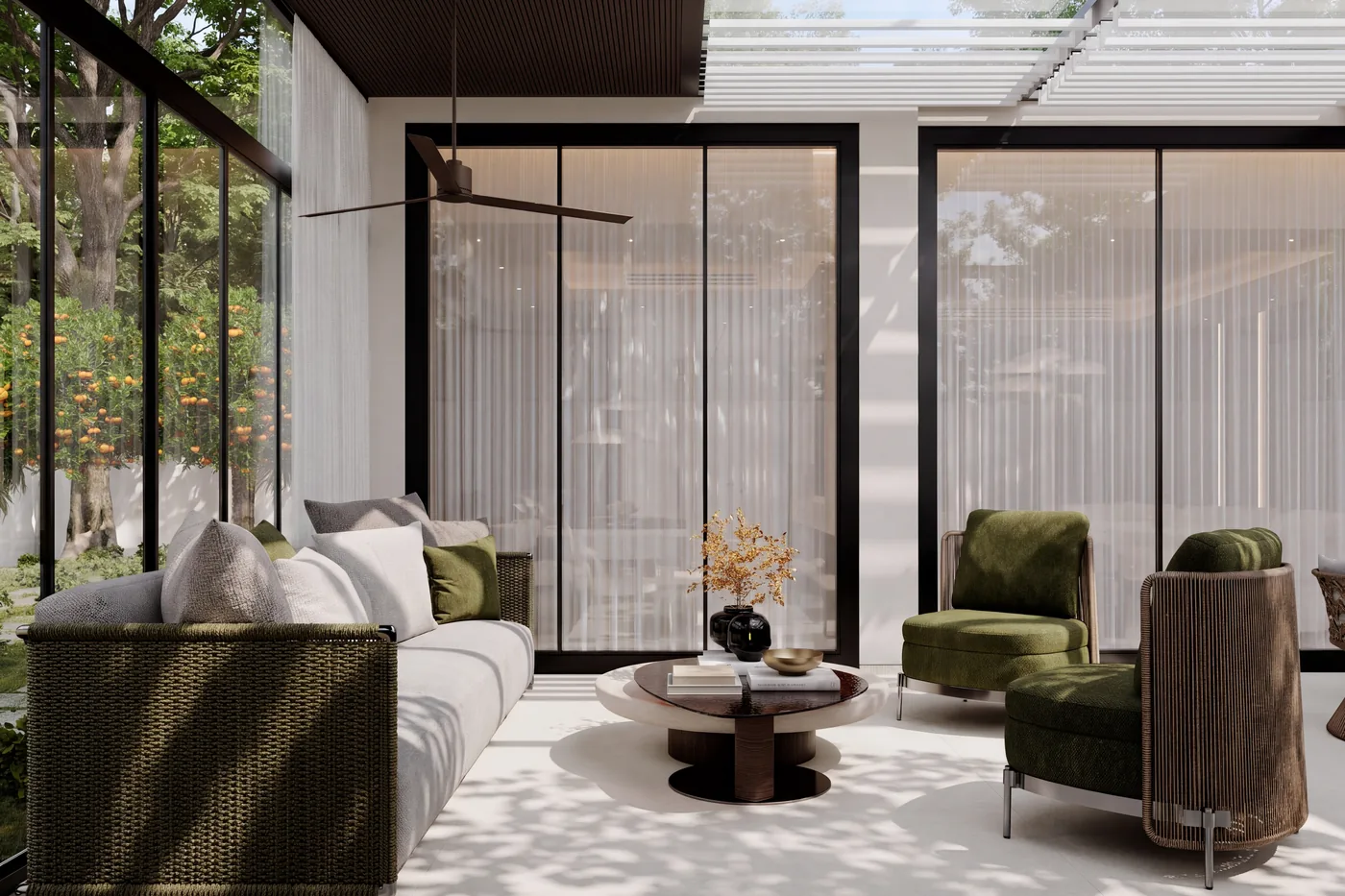
A sunroom turns part of a villa's garden or terrace into a room you can use most of the year: a bright, glazed space for breakfast, long lunches, reading or entertaining, with the garden on three sides. In Dubai it can also be the hardest room in the house to get right, because the same sun that makes it beautiful can make it unusable for half the year.
The difference between a sunroom that is used every day and one that sits empty from May to September comes down to a handful of decisions: where it faces, what glass and roof it has, how it is shaded and how it is cooled.
This guide walks through those decisions, the finishes and furniture that cope with heat and light, and how we plan a sunroom from the first sketch to handover.
Is a sunroom right for your villa?
A sunroom works best where it extends a room you already use. The most successful ones open directly off the living room, dining room or kitchen, so they feel like part of the house rather than a separate building at the end of the garden.
- Breakfast and family dining: a glazed dining area next to the kitchen, bright in the morning and comfortable in the evening.
- A second living room: sofas, armchairs and a coffee table for guests, with the garden as the backdrop.
- Entertaining: a larger table for dinners that would otherwise move outdoors only in the cooler months.
- A quiet corner: reading, a home office or a space for plants.
If the space will mainly be used in the winter months, a lighter, more open structure may be enough. If you want to use it all year, plan it as a proper room with insulated glass, shading and air conditioning from the start.
Start with orientation
Before choosing a single material, look at where the sun falls on that side of the villa through the day.
- North-facing: the most even, comfortable light and the least direct sun. The easiest orientation for a room used all year.
- East-facing: bright, pleasant mornings and shade in the afternoon. Ideal for breakfast and morning coffee.
- South-facing: strong sun for most of the day. Needs generous shading, especially on the roof.
- West-facing: the hardest. Low afternoon sun heats glass quickly and creates glare. Plan external shading and solar-control glass as essentials, not extras.
Existing trees, boundary walls and the neighbouring villa also matter. A sunroom shaded by mature planting can be far more comfortable than one in open sun.
The roof: the most important decision
Most of the heat in a sunroom arrives through the roof, so this is where the design starts.
| Roof type | What it gives you | What to consider |
|---|---|---|
| Glazed roof | Maximum light and a real sense of being outdoors | Needs solar-control, laminated glass and shading, or it overheats |
| Louvred aluminium roof | Blades that open for light and air and close for shade or rain | Motorised systems need power and maintenance; less insulated when open |
| Solid roof with skylights | The coolest option, with light where you want it | Less of a glasshouse feel; more like an extension |
| Solid and louvred | Shade over seating, open sky over plants | Careful detailing where the two meet |
In many Dubai villas a combination works best: a solid or insulated section over the main seating area and a louvred section that can open on cooler days. The sunroom in the photograph at the top of this article uses exactly that approach.
Glass, frames and doors
The walls of a sunroom are mostly glass, so the glazing does a lot of work.
- Double glazing with a solar-control or low-emissivity coating reduces the heat coming in while keeping the room bright.
- Laminated glass is the safer choice for roofs and large panels, because it holds together if broken.
- Thermally broken aluminium frames stop the frame itself from conducting heat. Slim profiles keep the view open.
- Sliding or folding doors let the room open fully to the garden from November to March.
- Good seals and drainage keep out dust and sand, and stop rainwater collecting at thresholds.
Ask for the glass specification in writing. Two panes that look identical on site can perform very differently in July.
Shade first, then cool
It is always easier to stop heat getting in than to remove it once it is inside. Layer the shading:
- Outside: louvred pergolas, roof overhangs, external screens or blinds, and trees that shade the glass in the afternoon.
- On the glass: solar-control coatings and, where needed, a light tint.
- Inside: sheer curtains that soften glare without blocking the view, and heavier curtains for privacy at night.
Sheer curtains on tracks around the room are one of the simplest upgrades. They turn harsh midday light into a soft glow and make the room feel calmer.
Keeping it comfortable in summer
Even with good glass and shading, a sunroom in Dubai needs cooling in the hottest months if you want to use it then.
- Air conditioning: either an extension of the villa's existing system or a dedicated unit sized for a glazed room, which needs more cooling than a solid room of the same size.
- Ceiling fans: they move air gently and make the room feel cooler at a higher thermostat setting, which also saves energy.
- Zoning: doors between the sunroom and the house let you close it off in peak summer without heating up the rest of the villa.
- Condensation: cooled glass in humid weather can mist on the outside. Correct glass, seals and air movement keep this under control.
Be realistic about July and August. Some families design the sunroom for October to May and accept that it will be used less in the height of summer. Others want it as a true all-year room. Both are fine, but the decision changes the specification.
Floors and finishes that handle heat
- Floors: large-format porcelain or natural stone in light, matt finishes stay cooler underfoot and reflect less glare. Very dark stone in direct sun becomes uncomfortably hot. Our guide on travertine, marble or porcelain compares the options.
- Walls: washable, light-coloured finishes that will not fade or mark easily.
- Ceilings: timber-effect slats or panels add warmth and help hide services such as air-conditioning grilles and speakers.
- Continuity: carrying the same floor from the living room into the sunroom makes both spaces feel larger.
Furniture and fabrics
Strong light fades and weakens ordinary furniture faster than you might expect.
- Outdoor-grade upholstery: solution-dyed fabrics resist fading and are easier to clean. Removable covers help.
- Frames: powder-coated aluminium, teak and woven rope or synthetic wicker handle heat and sun well.
- Tables: stone, ceramic or sealed timber tops that will not mark from heat or water.
- Comfort: deep seating and cushions make it feel like a living room rather than a terrace.
Choose a palette that sits well with the garden. Soft neutrals, natural textures and greens let the planting and the view take the lead.
Lighting for the evenings
Many sunrooms are used most after sunset, when the temperature drops. Plan the lighting as carefully as the daylight:
- Warm white light, around 2700K to 3000K, keeps the room relaxed. Our guide to warm white vs cool white explains why.
- Linear lights hidden in the roof structure or louvres, on dimmers.
- Uplights on trees and planting, so the garden still reads at night and the glass does not turn into a black mirror.
- Ceiling fans with integrated lights where a pendant is not practical.
Plants
Plants make a sunroom. Olive trees, ficus, palms, ferns and shade-tolerant tropical plants all work, depending on the light. Use planters with proper drainage, plan for automatic irrigation where you can, and keep larger plants away from air-conditioning outlets.
Approvals
Enclosing part of a garden or terrace, adding a roof or changing the facade usually needs approval from your master developer or community, and sometimes from the authorities, before work starts. Our guide on whether you need a NOC to renovate in Dubai explains how this works community by community.
How we design a sunroom
We start with how you want to use the space and when, then study the orientation and the way the sun crosses that side of the villa. From there we plan the layout, roof, glazing, shading, cooling and lighting together, because each one affects the others.
Before anything is built, 3D renders show the room at different times of day, so you can see how the light and shadows fall, choose finishes and furniture, and agree every decision. Our fit-out team then builds it under our own supervision through to handover.
Frequently asked questions
Can a sunroom be used in a Dubai summer?
Yes, if it is designed for it. That means an insulated or shaded roof, solar-control double glazing, external shading and proper air conditioning. A lighter structure without cooling is best treated as a room for the cooler months.
Is a glass roof or a louvred roof better?
A glass roof gives more light but needs strong shading. A louvred roof gives you control, open on cool days and closed in strong sun. Many villas combine a solid or insulated section over seating with a louvred section over planting.
Do I need permission to build a sunroom?
In most communities, yes. Enclosing outdoor space or adding a roof structure usually needs approval before work starts. Check with your developer or community management early in the design.
How long does a sunroom project take?
It depends on the size, the structure and the approvals. Design and approvals come first, then manufacture of the glazing and roof system, then installation and finishing. Our article on how long a villa renovation takes in Dubai explains each stage.
Can a sunroom be connected to the living room?
Yes, and it usually should be. Large sliding or folding doors and a continuous floor finish make the sunroom feel like part of the house, while still letting you close it off when needed.
Bring it home
A well-designed sunroom gives a villa a room that changes with the light: bright in the morning, shaded at midday and glowing in the evening. Get the orientation, roof, shading and cooling right, and it can become the room everyone gravitates to.
Planning a sunroom or a wider villa renovation in Dubai? See our interior design and fit-out services, or contact us to talk it through.
