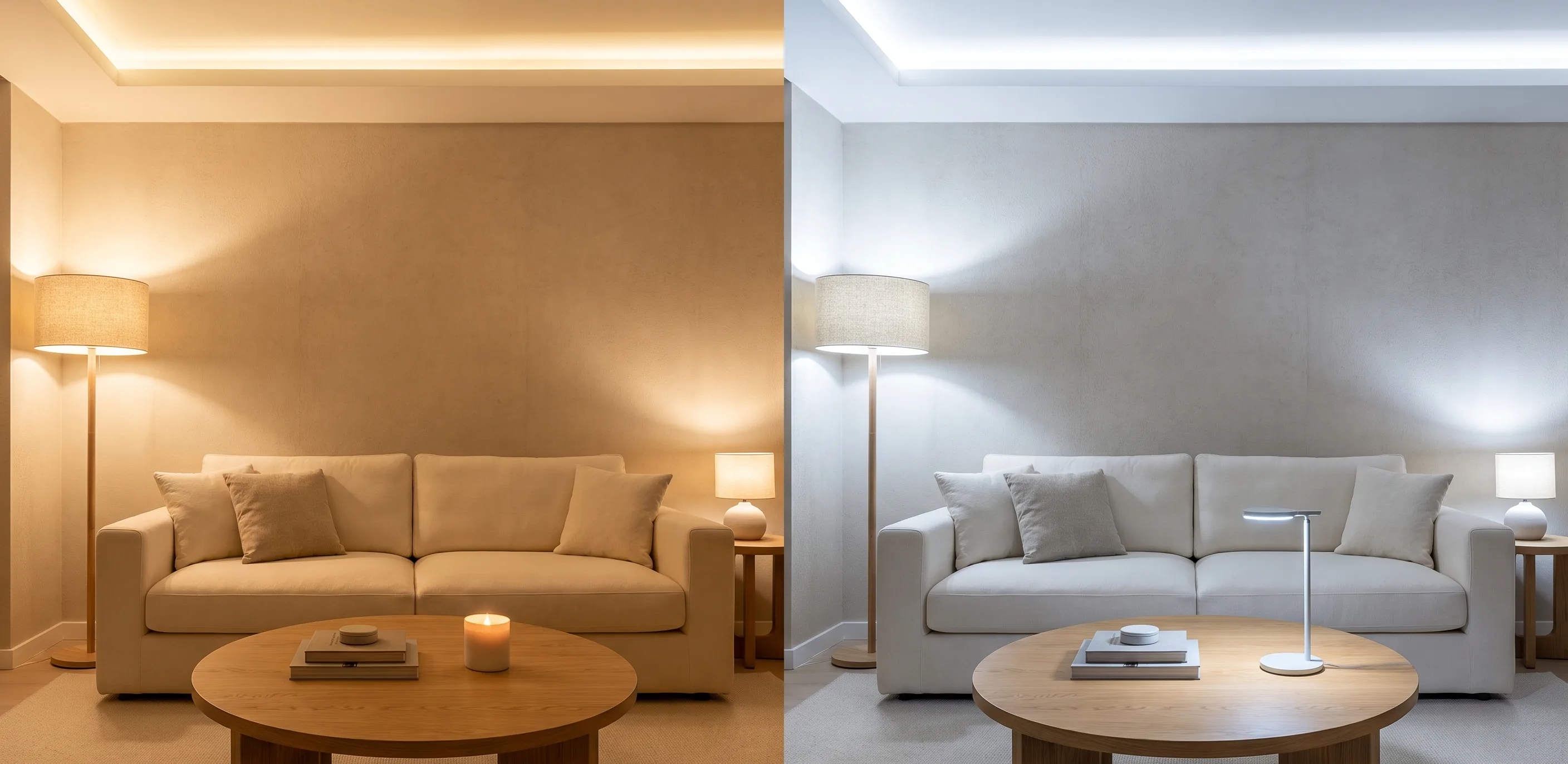
You have chosen the furniture, settled on the wall colours and found the perfect light fixtures. But when you switch the lights on, the room feels different from what you imagined.
The colour of your lighting could be the reason.
When comparing warm white vs cool white, warm white is usually a good starting point for relaxed spaces such as bedrooms and living rooms. Cooler or neutral white lighting can suit practical areas such as kitchens and workspaces. The right choice depends on how you use the room, its finishes and the atmosphere you want to create.
Here is how to choose lighting that works for your home.
What is the difference between warm white and cool white?
Warm white light has a yellowish tone, while cool white light has a crisper, less yellow appearance. This difference is described by colour temperature, measured in Kelvin (K).
Lower Kelvin numbers indicate warmer-looking light. Higher numbers indicate cooler-looking light. For example, 2700K to 3000K is typically warm white, while 4000K and above looks progressively cooler. ENERGY STAR explains the Kelvin scale here.
Lighting labels vary between manufacturers, so check the Kelvin number on the packaging rather than relying only on names such as "soft white" or "cool white".
| Colour temperature | Typical appearance | Suggested use |
|---|---|---|
| 2700K | Warm, with a noticeable yellow tone | Bedside lamps and relaxed living areas |
| 3000K | Warm white with a less yellow appearance | Living rooms, dining rooms and general home lighting |
| 3500K to 4000K | Neutral to cool white | Kitchens, bathrooms and work areas |
| 5000K to 6500K | Crisp, daylight-like white | Spaces where a distinctly cool appearance is preferred |
These room suggestions are starting points, rather than fixed rules. Your preferences and the way light interacts with your interior matter too.
Is cool white brighter than warm white?
Cool white can appear brighter or sharper, but colour temperature does not tell you how much light a bulb produces.
For brightness, check lumens. For the colour of the light, check Kelvin. The US Department of Energy recommends comparing lumens when choosing your desired light output. Read its guide to lumens.
If your living room feels too dim, switching to a cooler bulb may change its atmosphere without solving the problem. You may need more light output, better fixture placement or an additional lamp.
Warm white or cool white for the living room?
Start with 2700K to 3000K for a living room designed around relaxing and entertaining.
Try 2700K if you prefer a cosy evening atmosphere. Choose 3000K if you want warm lighting with a slightly cleaner appearance.
Consider where the light comes from as well. A single ceiling fixture may leave reading areas or corners poorly lit. Combine general lighting with a floor lamp beside a chair, table lamps near seating or accent lighting around shelving.
If the room also serves as a workspace, add a dedicated desk light. This gives you more control over that area without changing the atmosphere of the whole room.
Which light is best for a bedroom?
Warm white is a useful starting point for bedroom lighting, particularly for lamps used in the evening.
A 2700K bedside lamp creates a soft, warm effect, while 3000K may suit someone who prefers a little less yellow in the room.
Choose reading lights that direct enough light onto the page. A warm bulb can still provide practical reading illumination when its output and placement are suitable.
It also helps to control bedside lights separately from the main ceiling fixture. You can then move from general room lighting to a gentler evening setting.
Warm white or cool white for the kitchen?
Consider 3000K to 4000K for kitchen lighting, depending on the finishes and whether the kitchen connects to other living spaces.
A kitchen with timber cabinetry and warm-toned surfaces may suit 3000K. If you prefer a more neutral appearance, test 3500K or 4000K.
Pay particular attention to worktops. Ceiling lights behind you can leave your own shadow across the preparation area. Well-positioned under-cabinet lighting can help address this.
For an open-plan kitchen and living room, test the lights together. A noticeable jump from warm living room lamps to very cool kitchen lights may interrupt the atmosphere you are trying to create.
Which colour temperature works best in a bathroom?
3000K to 4000K is a practical range to test in a bathroom.
Try 3000K for a warmer, softer feel or around 4000K if you prefer a more neutral-looking space.
At the mirror, placement matters as much as colour temperature. Lighting from the sides can help reduce the facial shadows created by a strong overhead light.
Colour temperature also does not tell the whole story about how accurately skin tones, clothing or finishes appear. Colour rendering is a separate aspect of lighting quality, as explained in the Department of Energy's LED basics guide.
How to choose lighting that suits your interior
Before buying bulbs for the whole home, test your preferred colour temperature in the actual room.
Look at your materials
Compare the light against your walls, flooring, cabinets and fabrics. A bulb that looks appealing in a showroom may produce an effect you do not like against your own finishes.
Warm lighting can emphasise the warmth of timber, beige and earthy colours. More neutral lighting may suit you if you want less of a yellow cast.
Check the room after dark
Daylight can make differences between bulbs less noticeable. Test your lighting in the evening, when it has the greatest influence on the room.
Think about the activity
A dining area, reading corner and kitchen worktop have different lighting needs. Decide where you need atmosphere, where you need visibility and where you need both.
Keep connected spaces in mind
You do not need the same colour temperature throughout your home. However, similar temperatures in areas you can see at the same time can help the design feel cohesive.
Can you mix warm white and cool white?
Yes, but it works best when the choice is intentional.
For example, a warm bedside lamp and a more neutral dressing-area light can serve different purposes, especially when controlled separately.
Avoid accidentally mixing different colour temperatures in matching fixtures. Two wall lights beside the same mirror will usually look more consistent when their bulbs match.
If you want flexibility, consider lighting with adjustable white colour temperature. This lets you change the shade of white rather than choosing a single fixed setting. ENERGY STAR describes this feature as white colour tuning.
Frequently asked questions
Is 3000K warm white or cool white?
3000K is generally considered warm white. It has a warm appearance, usually with less yellow than 2700K.
Is 4000K too cool for a home?
Not necessarily. It can suit kitchens, bathrooms and work areas if you prefer a neutral-to-cool appearance. Test it against your finishes before committing.
Should every room have the same colour temperature?
No. Different rooms can use different temperatures. Aim for a considered relationship between adjoining spaces, particularly in an open-plan layout.
Does warm white use less electricity than cool white?
The colour label alone does not tell you how much electricity a bulb uses. Compare the wattage and lumen output of the specific products. The Department of Energy's bulb-buying guidance explains these specifications.
Choose lighting around the way you live
For relaxed living rooms and bedrooms, begin by testing warm white at 2700K to 3000K. For kitchens, bathrooms and work areas, compare options between 3000K and 4000K.
Then consider brightness, placement and how the light looks against your materials. The best choice is the one that makes your room comfortable and useful throughout the day.
Planning an interior refresh? Talk to Intrio about bringing lighting, finishes and furniture together in a home designed around you.
