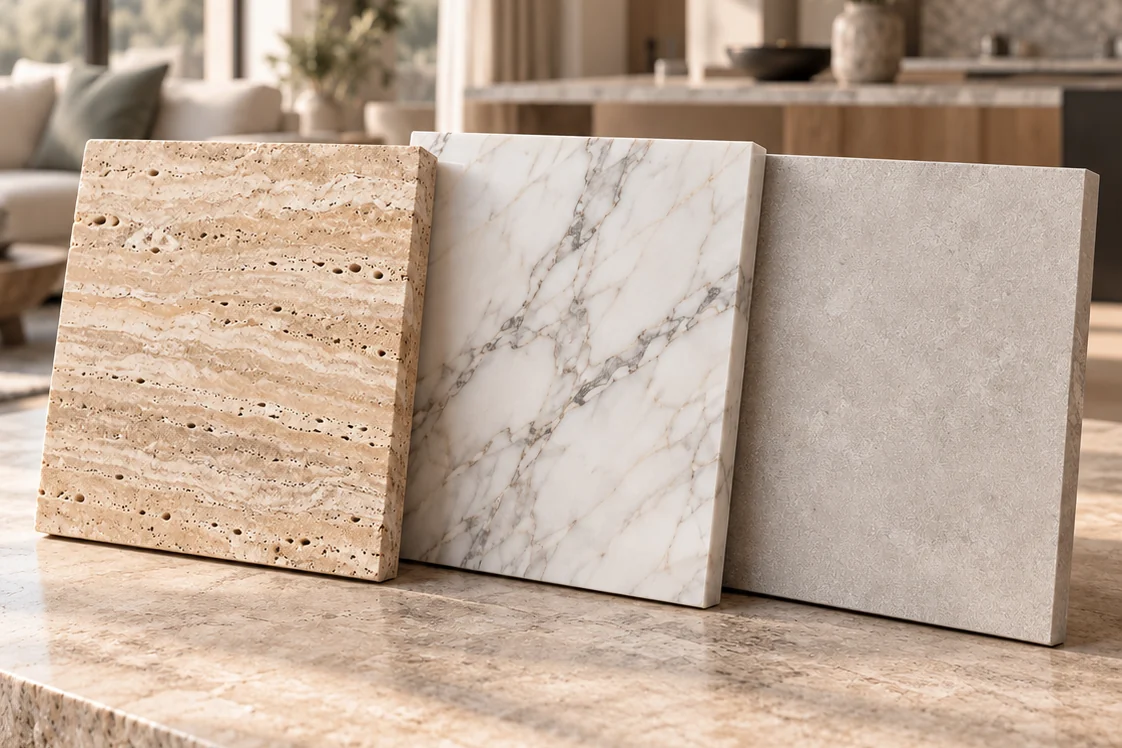
Few decisions shape the feel of a home as much as the surfaces underfoot and on the worktops. They are touched every day, they catch the light in every room and, once installed, they are not easily changed.
Travertine, marble and porcelain are three of the most requested finishes in Dubai homes today. Each can look beautiful. Each also behaves differently once it meets daily life, from morning coffee to sandy shoes and hard-working showers.
In short: choose marble when you want a statement surface and accept that it will gather a patina, choose travertine for a soft, warm and textured look, and choose porcelain when durability and low upkeep matter most. The right answer depends on the room, how you use it and how you feel about signs of wear.
Here is how to decide.
What is the difference between travertine, marble and porcelain?
Marble is a natural stone formed when limestone is transformed by heat and pressure. It is prized for its veining, depth and the way it takes a polish. No two slabs are identical.
Travertine is also natural stone, a form of limestone laid down by mineral-rich springs. It is known for its warm, earthy tones and the small natural holes that run through it. For floors and worktops these holes are usually filled at the factory, while unfilled travertine gives a more rustic, textured surface.
Porcelain is not a stone at all. It is a dense ceramic made from refined clay fired at very high temperatures. Modern porcelain can closely imitate marble, travertine, concrete or timber, and it is now available in large slabs as well as tiles.
Marble and travertine are both largely calcium carbonate. That shared chemistry explains much of how they behave, particularly their sensitivity to acids.
| Marble | Travertine | Porcelain | |
|---|---|---|---|
| Character | Veined, luminous, every slab unique | Warm, earthy, gently textured | Consistent, can imitate almost any material |
| Reaction to acids | Etches (dull marks) | Etches (dull marks) | Unaffected |
| Staining | Can stain if unsealed | Can stain if unsealed | Highly resistant |
| Sealing | Needed periodically | Needed periodically | Not usually needed |
| How it ages | Develops a patina | Develops a patina | Stays largely as installed |
| Best suited to | Feature walls, bathrooms, statement surfaces | Living areas, bathrooms, outdoor spaces | Kitchens, busy floors, outdoor spaces |
How marble behaves in daily use
Marble's appeal is easy to understand. A single slab can bring movement, light and a sense of permanence to a room in a way few materials can.
Its weakness is acid. Lemon juice, vinegar, wine, tomato sauce and many bathroom cleaners can leave dull marks known as etching. Etching is not a stain, and sealing does not prevent it. A sealer slows the absorption of liquids that cause stains, but acids still react with the surface of the stone.
A polished finish shows etching and scratches most clearly. A honed finish, which is smooth and matt, makes these marks far less noticeable and is often a better choice for kitchens and floors.
Some people see this gradual wear as a flaw. Others see it as character, the same quality that makes old marble in European homes and cafés so appealing. It is worth deciding which camp you are in before you choose a white marble worktop.
How travertine behaves in daily use
Travertine has a quieter, more relaxed presence than marble. Its warm beige, cream and walnut tones sit comfortably with timber, linen and natural textures, which is part of why it has become so popular in contemporary interiors.
Like marble, it is sensitive to acids and needs sealing. Its natural holes also need attention. On filled travertine, the filling can wear over many years and may occasionally need topping up. On unfilled travertine, the holes can collect dirt, so it is better suited to walls and decorative surfaces than to kitchen floors.
Its matt and textured finishes are forgiving. Minor wear tends to blend into the stone's natural variation rather than stand out.
Travertine is also a long-standing choice for terraces and pool surrounds. Lighter-coloured stone tends to stay more comfortable underfoot in strong sun than darker surfaces, and a textured finish offers better grip when wet. Ask your supplier about slip resistance and suitability for outdoor use before you commit.
How porcelain behaves in daily use
Porcelain is the practical choice. It absorbs very little water, resists stains and is unaffected by acids, and most porcelain does not need sealing. It handles heavy traffic well and is easy to clean.
Large-format porcelain slabs have changed what is possible. Kitchen islands, full-height shower walls and floors can now be finished with very few joints, giving a clean, continuous look that once required natural stone.
There are trade-offs. Because the pattern is printed, the same design can repeat across a floor. Look at several tiles or slabs laid out together before ordering. On many products the colour sits only on the surface, so a chip on an edge can reveal a different body colour underneath. Edge details on worktops need careful thought for the same reason.
And while the best porcelain is extremely convincing, it does not have the depth or subtle variation of real stone up close. For some rooms that matters. For others it will never be noticed.
Which surface works best in each room?
Kitchen
Porcelain is the most forgiving choice for kitchen worktops. It copes with acids, heat and spills without much thought.
If you love marble, consider a honed finish and accept that it will change over time. Alternatively, use marble where it is appreciated but less exposed, such as a splashback, shelf or feature wall, and choose a harder-wearing surface for the main preparation area.
Bathroom
All three can work well in a bathroom. The details matter more than the material.
Choose a honed or textured finish on shower floors for better grip. Use pH-neutral cleaners on marble and travertine. Many limescale removers are acidic, and they can etch natural stone quickly. Regular wiping of glass and walls after showering reduces the need for strong cleaning products.
Living areas and floors
Travertine and honed marble create beautifully calm floors in living rooms and bedrooms. Porcelain is a sensible choice where traffic is heavy or where a stone look is wanted at a more predictable cost.
In Dubai, fine sand carried in on shoes acts like sandpaper on polished surfaces. A good entrance mat and a honed or matt finish will help any floor keep its appearance.
Terraces and outdoor spaces
Travertine and outdoor-rated porcelain are both strong options. Porcelain made for exterior use is typically thicker and textured for grip. Whatever you choose, check that it is specified for outdoor use and suitable for wet areas if it will surround a pool.
What about cost?
Prices vary widely within each category, so it is difficult to generalise.
Marble ranges from relatively accessible varieties to rare stones sold slab by slab. Travertine usually sits in the middle. Porcelain is often the most economical, although premium large-format slabs can approach the cost of natural stone once cutting and installation are included.
Remember to compare the full cost rather than the price per square metre alone. Include wastage, cutting, edge finishing, installation, sealing and long-term care.
How to choose the right surface for your home
See large samples in your own light
A small sample in a showroom tells you little. Ask for large pieces, or see the actual slabs for natural stone, and look at them in the room where they will be used, both in daylight and under your evening lighting.
Be honest about how you live
A household that cooks every day, entertains often or has young children will put a surface to work. Choose a material whose way of ageing you will enjoy rather than tolerate.
Think about the whole palette
Stone rarely works alone. Consider how it relates to your joinery, flooring, metal finishes and fabrics. Warm travertine with walnut timber creates a very different mood from cool white marble with brushed steel.
Mix materials with intention
You do not need to use a single material throughout. Many of the most successful interiors combine them, for example a porcelain kitchen worktop, a marble vanity and travertine on a feature wall.
Frequently asked questions
Is travertine the same as marble?
No. Both are forms of calcium carbonate stone, but travertine forms around mineral springs and has natural holes and a softer look, while marble is formed under heat and pressure and is known for its veining.
Does marble need sealing?
Yes, marble should be sealed to help resist staining, and resealed periodically. How often depends on the stone, the finish and the sealer, so follow your supplier's recommendation. Sealing does not prevent etching from acids.
Can you use porcelain on a kitchen worktop?
Yes. Porcelain slabs made for worktops are highly resistant to heat, stains and scratches. Edge details and cut-outs need careful fabrication, so use an experienced installer.
Is travertine suitable for outdoor use in Dubai?
Yes, when it is specified for exterior use and finished for grip. It is widely used for terraces and pool surrounds. Seal it as recommended and use cleaners that are safe for natural stone.
Choose the surface that suits your life
Marble brings drama and depth. Travertine brings warmth and ease. Porcelain brings resilience and freedom from worry. None is the right answer for every home.
Start with how each room is used, then see real samples in your own space. The best surface is the one that looks right on the first day and still feels right years later.
Planning a new home or renovation? Talk to Intrio about selecting stone, finishes and furniture that work together in a home designed around you.
