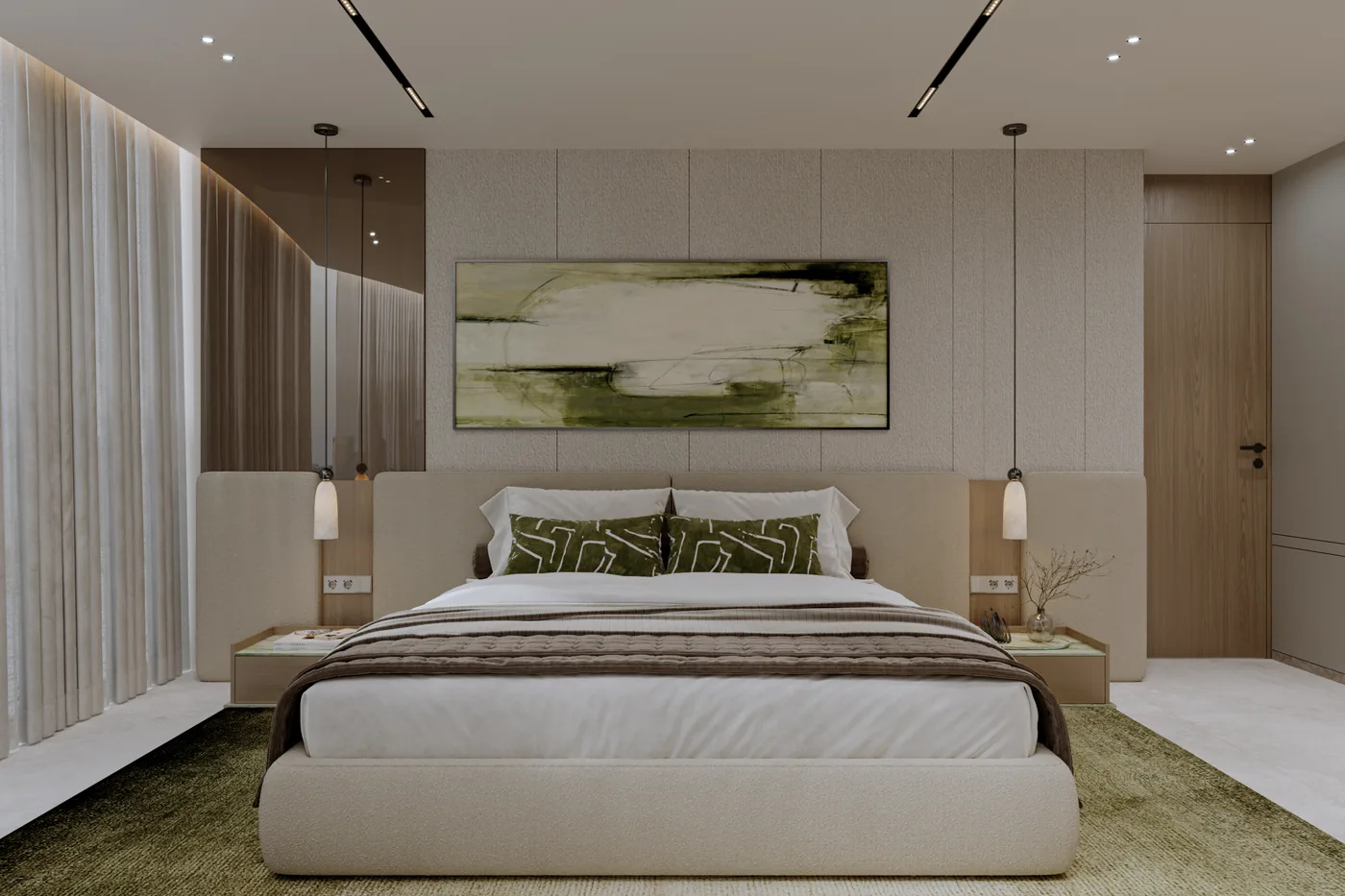
The master bedroom is the room you start and end every day in, yet it is often the last room to get proper design attention. Budgets go to the living room and kitchen, and the bedroom ends up as a bed, a wardrobe and whatever lighting came with the apartment.
In Dubai it deserves more thought than that. Strong sun, long summers and air conditioning that runs most of the year all shape how a bedroom feels at night and first thing in the morning. A well-planned master bedroom is quiet, dark when you need it to be, easy to keep tidy and calm to walk into.
This guide covers the decisions that make the biggest difference: layout and bed size, the headboard wall, lighting, curtains and blackout, cooling, storage, materials and the small details that are hard to add later.
Start with the layout
Before choosing a single finish, decide where the bed goes. Everything else, from lighting and sockets to the wardrobe and the air conditioning, follows from that one decision.
- Put the bed on the most solid wall. A wall without windows or doors gives you a proper headboard and room for bedside tables on both sides.
- See the door, not the bed, from the corridor. Where possible, place the bed so it is not the first thing visible from the doorway. The room feels more private straight away.
- Keep windows to the side. Morning light across the room is pleasant; light straight into your eyes at 6am is not. A bed facing a large window also makes blackout far more important.
- Leave space to walk. As a rule of thumb, aim for at least 70 cm of clear floor on each side and at the foot of the bed, and closer to 90 cm where you can. Tight walkways are the first thing that makes a bedroom feel cramped.
Choosing the right bed size
The bed sets the scale of the whole room. Too small and the room feels empty; too large and every walkway is squeezed. These are the mattress sizes most commonly sold in the UAE, though they vary between brands, so always confirm with your supplier before the joinery is drawn.
| Size | Typical mattress | Works best in |
|---|---|---|
| Queen | 160 x 200 cm | Smaller master bedrooms and most guest rooms |
| King | 180 x 200 cm | The usual choice for a master bedroom |
| Super king | 200 x 200 cm | Large villa bedrooms with generous walkways |
Remember that the bed frame and headboard add to the mattress size, often by 10 to 30 cm in each direction depending on the design. An upholstered bed with a deep, padded headboard can take up noticeably more floor than the mattress suggests.
Make the headboard wall the focus
In most bedrooms the wall behind the bed is the one you see every time you walk in, so it is where the design effort pays off most.
- Panelling: timber, fluted or upholstered panels add warmth and soften sound.
- A full-height headboard: upholstery or panelling that runs up the wall makes the bed feel built in and the ceiling feel taller.
- Integrated bedside units: floating side tables built into the headboard joinery keep the floor clear and make cleaning easier.
- Concealed lighting: a soft strip of light behind or above the headboard gives a gentle glow for evenings without a single bright point.
Plan sockets, switches and reading lights for this wall at the design stage. Once the panelling is installed, adding a socket or moving a light becomes a much bigger job.
Layer the lighting
A bedroom needs several kinds of light, each on its own control, rather than one bright ceiling light.
- General light: recessed downlights or a soft cove for cleaning, dressing and packing.
- Reading light: a wall light or pendant on each side, aimed at the pillow so one person can read while the other sleeps.
- Ambient light: concealed strips in the headboard, joinery or ceiling for a calm evening glow.
- Night light: a low, dim light near the floor or under the bed that guides you to the bathroom without waking you up fully.
Warm white is usually the right starting point for a bedroom, especially for the lights you use in the evening. Our guide to warm white vs cool white explains colour temperature in more detail. Dimmers, and switches you can reach from the bed, make a bigger difference to daily comfort than almost any finish.
Curtains and blackout
In Dubai, the sun rises early and strongly for much of the year, so blackout is not optional in a master bedroom. The most practical approach is two layers on separate tracks:
- A sheer layer that filters daylight and gives privacy during the day.
- A blackout layer that closes fully for sleep, ideally running past the edges of the window so light does not leak around the sides.
Recessed ceiling pockets for curtain tracks give the cleanest finish, because the tracks disappear and the curtains fall straight from the ceiling. Motorised tracks are worth considering for large windows or where the curtains are hard to reach. Our article on choosing the right curtains covers fabrics and styles.
Cooling and comfort
Air conditioning runs most of the year here, so how it is delivered matters at night.
- Keep air off the bed. Plan grilles and diffusers so the airflow does not fall directly on the pillow area.
- Choose quieter outlets. Linear slot diffusers set into the ceiling are usually less visible and quieter than large grilles.
- Put a thermostat within reach. A control near the bed, or one on your phone, avoids getting up to adjust the temperature.
- Think about sound. Upholstered headboards, rugs, curtains and fabric-wrapped panels all absorb sound and make the room feel quieter.
Storage and the dressing area
A calm bedroom is a tidy one, and that comes down to storage. If there is space, a separate walk-in wardrobe or dressing area keeps clothes, shoes and bags out of the sleeping area entirely. If not, a full-height built-in wardrobe along one wall is the next best option.
Sliding doors save floor space where a hinged door would clash with the bed or a walkway. Integrated lighting inside the wardrobe, drawers with dividers, and a full-length mirror all make daily routines easier. Our guide to custom joinery in Dubai explains wardrobe options, finishes and how built-ins are made.
Materials, colour and texture
Bedrooms work best with a restrained palette and plenty of texture. Soft neutrals, warm timber, natural stone and a single accent colour, often from the rug, art or bedding, tend to age better than strong trends.
- Floors: timber or timber-look flooring feels warmer underfoot than large-format tiles, and a large rug under the bed softens the room further.
- Walls: matt paint, fabric or timber panelling reduce glare and echo.
- Fabrics: choose upholstery that is easy to clean, because fine dust finds its way into every home here.
- Hardware: handles, light fittings and taps in the same finish, repeated through the bedroom and en-suite, make the suite feel designed as one.
Connecting the en-suite
The master bedroom and its bathroom are best designed together. A continuous material, such as the same timber or stone, carried from the bedroom into the en-suite makes both spaces feel larger. Think about privacy too: the view from the bed should not look straight into the toilet, and a pocket or sliding door can save space where a hinged door would get in the way.
The details worth planning early
- Sockets with USB charging on both sides of the bed
- A two-way switch at the door and at the bed for the main lights
- A dedicated socket and concealed cabling for a TV, if you want one
- A small bench or seat at the foot of the bed or in the dressing area
- A full-length mirror, ideally where it does not reflect the bed
- Space for a reading chair or a small desk, if the room allows
None of these cost much at the design stage. All of them are harder to add once the walls are finished.
How we design a master bedroom
At Intrio, a bedroom starts with a measured layout and a conversation about how you actually use the room: when you sleep, who reads in bed, how much hanging space you need, and how dark you want it. From there we develop the layout, the headboard wall, the lighting plan and the joinery, and show it in 3D visualisation before anything is made. Our interior design and custom furniture and joinery teams then take it through to installation.
Frequently asked questions
What size bed is right for a master bedroom?
A king (usually 180 x 200 cm in the UAE) suits most master bedrooms. A super king needs a generous room with space to walk on both sides. Measure the frame and headboard, not just the mattress, before deciding.
How much space should I leave around the bed?
As a rule of thumb, at least 70 cm on each side and at the foot, and closer to 90 cm where the room allows. Allow more where a wardrobe door or drawer opens towards the bed.
What colour temperature is best for bedroom lighting?
Warm white is a good starting point for bedrooms, particularly for lamps and lights used in the evening. Keep each type of light on its own dimmable circuit so you can set the mood.
Do I need blackout curtains in Dubai?
For a master bedroom, almost always. Early, strong sunlight for much of the year makes a blackout layer, ideally on its own track behind a sheer, one of the most useful things you can add.
Can a bedroom be redesigned without a full renovation?
Yes. New lighting, a headboard wall, curtains and furniture can transform a bedroom without changing the layout. Our article on fit-out vs renovation explains the difference in scope.
Bring it home
A master bedroom does not need to be large to feel luxurious. It needs a bed that fits, light you can control, darkness when you want it, quiet cooling and storage that keeps everything else out of sight. Get those right and the finishes have room to shine.
Planning a new master bedroom or a wider home renovation in Dubai? See our interior design services, or contact us to talk it through.
