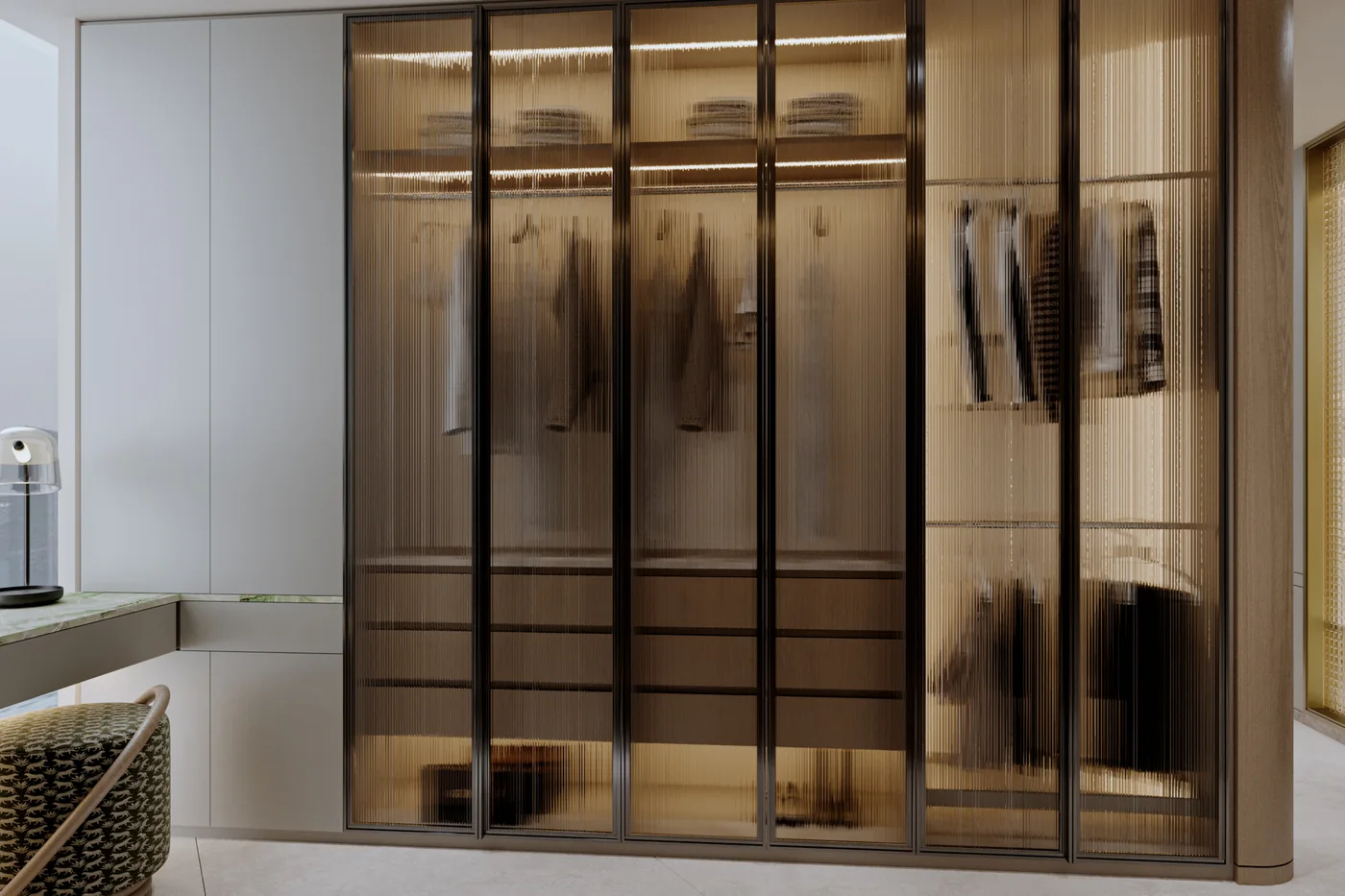
Custom joinery is the built-in furniture made to measure for one room: wardrobes, TV walls, vanities, headboard walls and storage that fit the space exactly. In Dubai homes, where walls are rarely perfectly straight and every centimetre of storage counts, it is often what makes a villa or apartment feel finished.
Ready-made furniture is designed for an average room. Joinery is designed for yours. It can run from floor to ceiling, hide air-conditioning access, wrap around a column and line up with the doors, windows and lighting around it. Done well, it disappears into the architecture. Done badly, it is the first thing you notice.
This guide explains what custom joinery covers, which materials and finishes work best in Dubai's climate, the details that separate good joinery from average, and how a joinery project runs from first sketch to installation.
What counts as custom joinery?
Joinery is any fitted piece made in a workshop to drawings for a specific space, then installed on site. The most requested pieces in Dubai homes are:
- Wardrobes and dressing rooms: full-height units with hanging, drawers, shoe storage and lighting, planned around what you actually own.
- TV and media walls: a cladded wall with a floating unit below, hidden cable routes, ventilated space for equipment and often a feature finish such as stone or fluted timber.
- Headboard and bed walls: upholstered or panelled walls that frame the bed, with integrated bedside shelves and reading lights.
- Vanities and washroom cabinets: stone tops on moisture-resistant cabinets, mirror cabinets and open shelves for towels.
- Entrance and storage walls: shoe cabinets, coat storage and full-height cupboards that keep everyday clutter out of sight.
- Study and office walls: desks, shelving and closed storage built as one piece.
- Majlis and display units: shelving and niches for objects, books and lighting, designed around the seating.
Why made to measure suits Dubai homes
Many Dubai villas and apartments have generous ceiling heights, bulkheads for air conditioning, and walls that are not perfectly square. Freestanding furniture leaves gaps above, behind and beside it, and those gaps collect dust and make a room look unfinished.
Joinery is drawn to the real measurements of the room, so it can fill the full height, follow an uneven wall and leave access to valves, AC units and sockets exactly where they are needed. It also lets you plan storage around your life: how many shoes, how much hanging space, where the iron, the luggage and the vacuum go.
Materials and finishes
The carcass, the box behind the doors, is usually moisture-resistant MDF or plywood. What you see is the finish. Each has its own look and suits different rooms:
| Finish | Look | Best for | Keep in mind |
|---|---|---|---|
| Natural timber veneer | Real wood grain, warm and tactile | Wardrobes, TV walls, bed walls | Match veneer from the same batch so every panel's grain and colour agree |
| Matt lacquer | Smooth, seamless, any colour | Kitchens, modern bedrooms, children's rooms | Choose a quality lacquer; cheap finishes chip at the edges |
| High-pressure laminate | Durable, many wood and stone looks | Utility rooms, offices, rental properties | Edges show if the edging is poorly applied |
| Fluted or ribbed panels | Texture and shadow | Feature walls, headboards, vanity fronts | Harder to clean; best used in one area, not everywhere |
| Solid timber | Strongest character | Shelves, handles, frames | Moves with humidity, so it needs careful detailing |
In washrooms and kitchens, ask for moisture-resistant boards and sealed edges. Dubai's humidity, especially in villas near the sea, punishes cheaper materials within a few summers.
Choosing the stone for a vanity or TV wall at the same time helps the whole room work together. Our guide on travertine, marble or porcelain explains the differences.
The details that make good joinery
Two wardrobes can use the same materials and still look completely different. The difference is in the details:
- Shadow gaps: a small, even recess between joinery and walls or ceilings makes pieces look deliberate and hides small movements in the building.
- Handle-free doors: push-to-open mechanisms or a finger groove keep fronts clean, especially on full-height wardrobes and TV walls.
- Quality hardware: soft-close hinges and full-extension drawer runners from established makers last for years of daily use.
- Integrated lighting: LED strips hidden in shelves, inside wardrobes and under floating units, with diffusers so you see the light, not the dots.
- Ventilation and access: media walls need airflow for equipment, and access panels for AC, valves and cables should be planned in, not cut out later.
- Scribing to the wall: panels trimmed on site to follow uneven walls and floors, so there are no visible gaps.
- Grain and alignment: veneer grain running continuously across doors, and door lines aligned with shelves, windows and ceiling details.
How a joinery project runs
A good joinery project follows clear steps, with your approval at each one:
- Brief and design: what each piece needs to store and how it should look, usually shown in 3D renders so you see it in the room first.
- Site measurement: taken once walls, ceilings and flooring are in place, because joinery is fitted to the finished surfaces.
- Detail drawings: every piece drawn to the millimetre for the workshop, with elevations, sections and the location of lights, sockets and hardware. Checking these drawings carefully is the best way to avoid surprises.
- Samples and approval: you approve the actual veneer, lacquer colour, stone and handles before production starts.
- Workshop production: panels are cut, finished and pre-assembled in the workshop, where quality is easier to control than on site.
- Installation and adjustment: pieces are installed, scribed to the walls and adjusted so every door and drawer runs smoothly.
- Handover: a final check together, with care notes for each finish.
In a full renovation, joinery is usually one of the last trades on site, so its timing affects the whole programme. Our guide to how long a villa renovation takes in Dubai shows where it fits.
Caring for joinery in Dubai's climate
Most joinery problems come from moisture, heat and harsh cleaning, not from age. A few habits keep it looking new:
- Keep air conditioning running at a steady level, even when you travel, so timber and boards do not swell and shrink.
- Wipe water from vanity tops and cabinet edges straight away.
- Clean veneer and lacquer with a soft, slightly damp cloth; avoid abrasive pads and strong chemicals.
- Keep direct sun off natural veneers with curtains or blinds, as strong light changes their colour over time.
- Have hinges and runners adjusted after the first months, once everything has settled.
Frequently asked questions
How long does custom joinery take?
It depends on the number of pieces and the finishes. Design and detail drawings come first, then samples and approval, then workshop production and installation. Allow several weeks from approved drawings to installation, and longer for special veneers or stone.
Is MDF good enough for joinery?
Yes, when it is the right grade. Moisture-resistant MDF is stable, takes veneer and lacquer well and does not warp like some solid timber. The quality of the finish, edges and hardware matters more than the board itself.
Is custom joinery worth it compared with ready-made wardrobes?
For full-height storage, awkward spaces and feature walls, usually yes. Joinery uses the whole wall, fits the room exactly and is planned around what you own. For a quick, temporary solution, ready-made furniture can make sense.
Do I need approval to install joinery in my apartment or villa?
Fitted joinery is often part of wider interior works, and many communities require a NOC before work starts. Our guide on whether you need a NOC to renovate in Dubai explains what to check.
Can I see the joinery before it is made?
Yes. 3D renders show how it looks in the room, and detail drawings show exactly how it is built. Approving both, along with physical samples of the finishes, means there are no surprises at installation.
Bring it home
Good joinery is quiet. It fits the room so well that it feels like part of the architecture, and it makes daily life easier every time you open a door or a drawer.
Planning wardrobes, a TV wall or a full villa renovation in Dubai? See our custom furniture and joinery and fit-out services, or contact us to talk it through.
