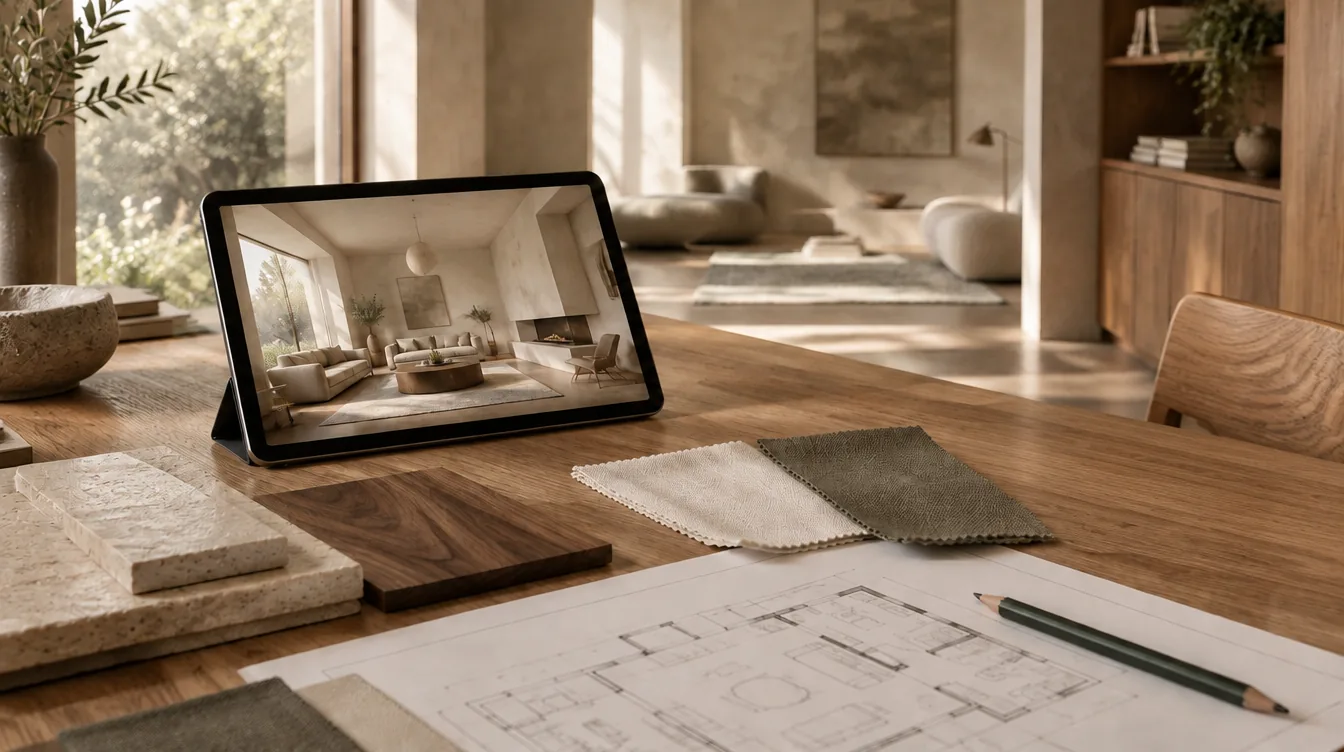
A beautiful image can suggest how a room might look. Good design considers how it will feel, function and support the people who use it.
This distinction sits at the heart of the conversation about AI in interior design. Artificial intelligence offers new ways to explore ideas, experiment with aesthetics and communicate a creative direction. Used thoughtfully, it can be a valuable part of the design process.
Yet an appealing visual is only a starting point. Turning it into a space that works requires decisions about proportion, materials, budget, construction and everyday life. That is where human experience remains essential.
For Intrio, the opportunity lies in understanding both the possibilities of AI and the boundaries of what it can deliver.
Opening up the creative conversation
The early stages of interior design are often about discovery. A client may know the atmosphere they want without knowing how to describe it. Words such as warm, minimal or luxurious can mean very different things to different people.
AI interior design tools can help make those conversations more visual. They offer a way to explore colour palettes, furniture ideas, material combinations and different styles before committing to a direction.
A living room might be imagined with pale oak and soft linen, then reconsidered with darker timber and richer textures. These quick visual studies can help a client recognise what appeals to them and, just as usefully, what does not.
For designers, this creates another source of interior design inspiration. An unexpected combination may prompt an idea worth developing. A series of variations may help clarify which elements give a concept its character.
The value is in opening up possibilities and giving the design conversation a clearer starting point.
Helping clients express what they like
People do not always respond to an image for the reasons they first assume.
A client might share an AI-generated interior because they love its calm atmosphere, rather than its furniture. Another might be drawn to the warmth of the lighting or the contrast between smooth stone and textured fabric.
A designer can look beyond the overall image and identify those preferences. From there, the conversation becomes more specific: Is it the natural palette? The sense of openness? The softness of the materials?
Used this way, AI supports communication. It helps turn a broad feeling into a direction that can be explored, questioned and refined.
But once a direction has been established, a different kind of work begins.
Why an AI-generated interior is not a finished design
A convincing image can make a room appear resolved before its practical details have been considered.
AI-generated interiors may show furniture with unrealistic proportions, windows that do not match the property or layouts that leave too little space to move comfortably. A chair may look desirable without corresponding to an actual product. A seamless wall detail may conceal a junction that cannot be constructed as shown.
Lighting can be equally misleading. An image may suggest a soft, even glow without accounting for window orientation, neighbouring buildings or the placement of real light fittings.
These limitations matter because visual appeal and feasibility are different things.
Before a concept can become a finished interior, someone must measure the space, check clearances, coordinate services and establish how its components will fit together. Technical drawings and site verification provide information that an inspirational image alone cannot.
The more convincing the visual, the more important it is to remember what remains unresolved.
Designing around the life behind the image
A successful interior responds to the people who live or work within it.
It considers where bags are dropped at the end of the day, how much storage is needed, whether a family entertains regularly and which spaces need privacy. It accounts for comfort, accessibility, maintenance and routines that may never appear in a mood board.
AI can work with information supplied to it, but it cannot independently establish whether that information fully reflects the client’s life or the realities of the property.
Human designers ask follow-up questions. They notice competing priorities and help clients make choices between them. An open layout may look attractive, for example, while creating difficulties with noise or privacy. A pale upholstery fabric may suit the concept but require more care than the household wants.
These decisions shape whether a space remains enjoyable long after the first impression.
Materials need to work beyond the screen
Material selection is another point where digital inspiration needs physical judgement.
A stone surface may look beautiful in a rendering, but its suitability depends on its finish, maintenance requirements, cost and intended use. A fabric needs to be touched and assessed for durability. Timber samples need to be considered alongside neighbouring finishes and under the light of the actual space.
Availability matters too. The exact material suggested by an AI image may not exist or may not be available within the project’s budget and programme.
A designer translates the visual intention into choices that can be sourced and specified. Sometimes that means finding a close alternative. Sometimes it means changing the idea to achieve a better result.
This is where a colour palette becomes a considered material scheme, with each element selected for how it performs as well as how it looks.
Bringing the concept into the real world
Every project has constraints. Existing structures, ceiling heights, service locations, delivery access and installation requirements all influence what can be achieved.
Budgets also need to cover more than the objects visible in an image. Preparation, fabrication, installation and the less visible technical work are part of delivering the finished space.
The designer and technical team bring these considerations together. Through drawings, specifications, supplier coordination and site experience, they develop the concept into something that can be built.
Human judgement is especially valuable when conditions change. A material becomes unavailable. A site measurement reveals a discrepancy. A detail needs adjusting during installation. Resolving these situations requires an understanding of the overall design and the consequences of each decision.
Intrio’s perspective: creativity supported by judgement
At Intrio, AI can support creativity as part of a wider, carefully considered design process. It can help explore possibilities, communicate an atmosphere and introduce directions for further development.
It does not replace the designer, technical team, material selection or site experience. Those disciplines give an idea its substance and connect it to the client’s needs.
The aim is to use the right tools at the right stage, while keeping human judgement at the centre of the work. A compelling concept deserves careful questioning, practical development and thoughtful execution.
The future of design is not AI versus designers. It is designers who know when to use AI and, more importantly, when not to.
